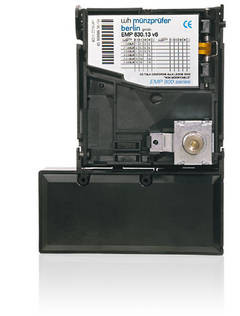
What are the technical specs of the SRT500 3+1-way coin sorter for EMP 830 series?
- item number: SRT500
- design: 3+1-way sorter (3 routes plus reject handling)
- compatibility: mounts to emp 830 series electronic coin selectors
- sorting principle: controlled via parallel coin output lines 5 and 6
- supported coin size: up to 31.5 mm diameter and 2.6 mm thickness
- power supply: 12–24 V DC
- system interface options: parallel, serial, USB, ccTalk (depending on the installed selector variant)
- data interface: pulse
- operating conditions: indoor 10–40 °C
- weight: 700 g/pcs
How does 3+1-way sorting improve payment process stability?
When you need multiple coin routes, the SRT500 3+1-way coin sorter for EMP 830 series helps keep the mechanical flow aligned with your control logic. Validated coins can be directed into separate collection paths, dedicated cash boxes or service-specific routes, while the “+1” route supports clean handling of rejected items. The logic based on parallel output lines 5 and 6 is fast and predictable, which helps reduce queue time and minimizes manual intervention.
Where is the SRT500 3+1-way coin sorter for EMP 830 series a strong fit?
It is well suited for unattended payment points where stable cash handling is critical: vending machines, parking pay stations, car wash systems, access control points, ticketing devices and other self-service equipment. indoor 10–40 °C operation matches typical cabinet environments, while 12–24 V DC power is common in industrial designs, simplifying electrical planning.
What should you align for fast integration and compatibility?
This sorter is built around the EMP 830 family, so start by confirming the exact selector variant and how your controller interprets the sorting signals. The product data states sorting is performed through the selector’s parallel outputs 5 and 6; in broader deployments you may also meet serial USB or ccTalk environments depending on the installed selector interface. Correct harnessing, a documented mapping of outputs to routes, and a clean mechanical coin path together deliver consistent performance.
Selection criteria checklist
Coin set and coin path
- verify coin dimensions: up to 31.5 mm diameter and 2.6 mm thickness
- define the 3 output routes: collection, payout/change, dedicated container or service-specific routing
- design for easy cleaning to reduce dust-driven friction and jams
Electrical and communication
- size power for 12–24 V DC and keep headroom for the full cash-handling chain
- wire and document parallel outputs (5 and 6) and map them to your routing logic
- if your deployment uses serial USB or ccTalk, align controller-side compatibility early
Operations and scaling
- keep indoor 10–40 °C conditions stable and ensure cabinet airflow
- plan service access: quick cleaning, quick swaps and clear cable routing
- prepare a spare-part and swap-unit strategy for multi-site rollouts
How do quality, local support and maintenance protect uptime?
Coin sorting reliability depends on long-term mechanical stability and a predictable coin path. Routine cleaning and inspection reduce jams and misrouting. Local technical support speeds up integration checks and troubleshooting, which is especially valuable in scaled deployments where downtime directly impacts revenue and customer flow.
- planned maintenance: coin-path cleaning, mounting checks, load testing
- service: fast diagnostics, swap options, installation and configuration guidance
- operating conditions: stable power, vibration mitigation, dust and moisture control inside the cabinet
Procurement and financing options that keep projects moving
- stock availability for critical modules and accessories
- timed arrivals aligned to rollout waves
- flexible shipping methods for standard and urgent needs
- customs and forwarding support for smoother logistics
- post-payment and invoicing in foreign currency for cash-flow planning
- project-tailored quotations based on quantities, schedule and integration scope
CTA: build an interest list and send it at the end of your visit
If you find other cash-handling, display, touch or control components that could be useful beyond your current project, add them to your interest list (cart). At the end of your visit, send the list and you’ll receive feedback on compatibility, stock status, delivery options and a project-aligned quotation.
FAQ
Why does multi-output coin sorting matter in unattended payment points?
Multiple routes help separate collection paths and simplify emptying and service operations, reducing handling errors. this organized coin flow is often missing in entry-level setups.
How is sorting controlled in the SRT500 system?
Sorting is triggered through the coin selector’s parallel outputs 5 and 6, and the overall system may also be deployed with serial USB or ccTalk interfaces depending on the selector variant.
What maintenance helps keep sorting consistent?
Regular coin-path cleaning, checking mounts and performing load tests reduce jam risk and misrouting, keeping transaction flow predictable.
Which industrial capabilities are typical for advanced coin sorters?
Standardized mounting, multiple output routes, documented signaling, wide dc power range and long-term service support are common features designed for continuous-duty operation.