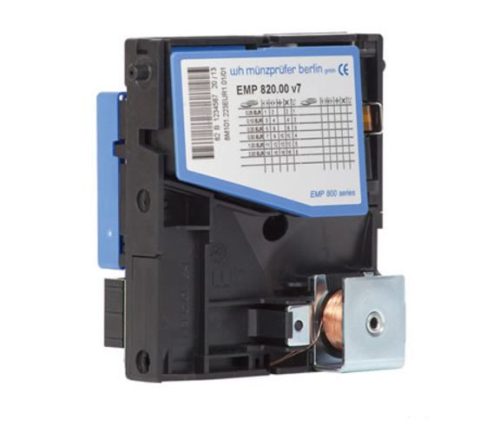
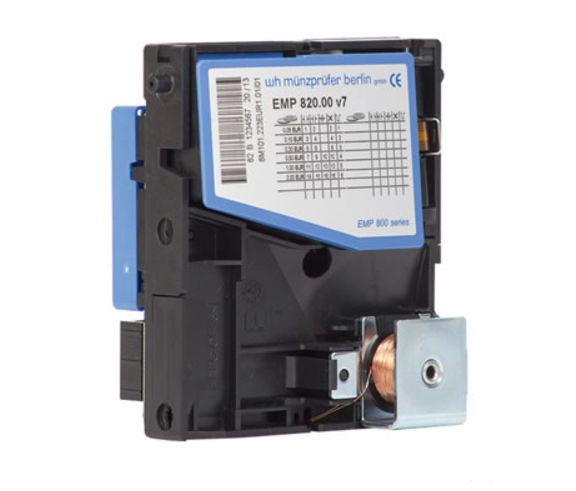
What are the technical characteristics of the EMP860v7?
- validation capacity: 32 active channels for up to 16 coins or tokens
- communication: cctalk / mdb (variant dependent) for controller integration
- mechanics: top entry (top-insertion) with front reject design
- acceptance rate: around 98% (depends on setup and coin set)
- max coin size: 32.5 × 3 mm
- power input: 10–26 V DC; current draw: 30–300 mA
- dimensions: 104 × 53 × 93.5 mm (without front plate)
- temperature range: +10…+70 °C; extended option: −20…+70 °C
- operations: coin and currency blocking via dip-switch, teach mode, flash firmware updates
- extras: optional remote programming, configuration cloning and update via pc software
Where does the EMP860v7 deliver the most value?
Choose the EMP860V7 when coin acceptance must stay consistent under continuous load and you need strong protection against manipulation attempts. The 32-channel architecture gives you room to manage multi-denomination sets and tokens, while ccTalk/MDB connectivity supports cleaner integration with common cash-handling controllers. Typical use cases include parking payment, car wash lanes, self-service laundry, vacuum stations, ticket vending and access control systems.
What do top entry and front reject mean in practical installation?
Top entry supports compact front-panel layouts and straightforward coin insertion paths, while front reject helps keep rejected coins managed and visible to the user. Together, they can reduce service calls caused by coin flow issues and improve transaction flow in high-traffic environments.
How does it support faster setup and multi-site rollouts?
Teach mode enables on-site configuration without extra programming equipment, which is useful when your token set changes or you deploy across multiple locations. Dip-switch based blocking gives operational control over accepted coins or currencies, and flash firmware updates help maintain long-term consistency. For repeated installations, cloning and update workflows support standardized configuration and faster service swaps.
Selection criteria: what should you verify before choosing?
- coin set: denominations, tokens, max dimensions, need for complex coin recognition
- communication: cctalk vs mdb expectations and controller-side protocol support
- mechanical integration: top-entry opening, front reject path, service access
- environment: dust/moisture, vibration, temperature; do you need −20…+70 °C
- operations: on-site teach needs, blocking strategy, firmware update process
- serviceability: fast replacement, spare parts availability, standardized settings
Why quality, local support and routine maintenance matter
When a coin acceptor module stops, revenue and user trust drop immediately. Industrial hardware performs best with clean coin paths, correct installation and periodic checks that keep acceptance accuracy stable. Access to local technical support and a fast service workflow reduces downtime, while preventive maintenance lowers the chance of unexpected outages.
- preventive checks: clean the coin path, verify mountings, test with real coins/tokens
- operating conditions: reduce dust/moisture, minimize shocks, keep 10–26 V DC stable
- local support: troubleshooting, setup guidance, firmware and replacement workflow
Which procurement and financing options can support your project?
- stock availability for critical components
- scheduled inbound deliveries aligned to phased rollouts
- selectable shipping methods, customs handling and freight coordination
- post-payment options and invoicing in foreign currency
- project-tailored quotations and volume-aligned commercial terms
CTA: save items to your interest list for later comparison
If you find cash-handling modules or interface components you may need later, add them to your interest list (cart). At the end of your visit, send the list and we’ll respond with compatibility notes, delivery options and a configuration approach aligned to your operating conditions.
FAQ
Why is ccTalk/MDB communication useful on an industrial coin acceptor?
Because it enables status and diagnostic reporting to the controller, helping faster troubleshooting and higher uptime compared to simple pulse-only wiring.
How does teach mode help during commissioning?
It supports on-site configuration without extra programming tools, so you can adjust the coin or token set quickly during rollouts.
What is a typical capability industrial validators offer that entry-level devices often miss?
Higher recognition accuracy with stronger anti-manipulation protection, more channels for diverse coin/token sets, plus updateable firmware and integration that supports remote diagnostics.
How can you reduce false rejections in high-traffic environments?
Keep the coin path clean, stabilize the power input, mount the unit to minimize vibration, and periodically validate settings with the real coins/tokens used.