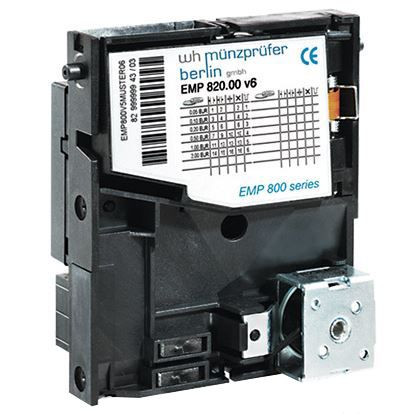
What are the technical specs of the EMP 820 electronic coin selector?
- acceptance: 32 active channels, programmable for up to 16 coins or tokens
- acceptance rate: typically up to 98%
- maximum coin size: 32.5 × 3 mm
- supply voltage: 10–26 V DC
- current consumption: 30–300 mA
- dimensions: 104 × 53 × 93.5 mm (without front plate)
- operating range: +10…+70 °C; optional -20…+70 °C with extended humidity class
- communication: MDB; the series is available with additional industrial interfaces (e.g., ccTalk, pulse, USB)
- functions: teach mode, coin/currency blocking via DIP-switch, flash firmware updates, cloning and configuration transfer
- security: innovative measuring system for strong fraud resistance, support for bi-colour coin recognition
What business need does an industrial coin validator solve?
When coin payments must stay fast and predictable, the EMP 820 electronic coin selector delivers stable validation and standard MDB integration into vending and self-service control electronics. The 32-channel design helps you handle denominations and tokens with fewer rework cycles, while teach mode simplifies changeovers during rollouts. A high acceptance rate supports smooth customer flow, and advanced sensing helps reduce revenue leakage caused by manipulated inserts.
Where does the EMP 820 electronic coin selector fit best in high-duty cash handling?
Typical deployments include parking systems, car wash payment points, ticketing machines, vacuum stations, laundries and access control installations. Optional extended environmental capability supports demanding locations, and series-level compatibility with multiple interface variants helps you keep a consistent spare-parts and configuration strategy over long lifecycles.
Selection criteria checklist
Integration and communication
- confirm your controller expects mdb and define the required harness and pinout
- size the power supply for 10–26 V DC and keep headroom for peak load
- design the coin path: inlet, reject route and any external sorting flap control
Coin set and commissioning
- verify max coin dimensions (32.5 × 3 mm) and the needed channel count
- include tokens and bi-colour coins if your payment logic requires it
- use dip-switch blocking for controlled acceptance rules and operational governance
Reliability and operations
- choose the right environment spec: standard +10…+70 °C or extended -20…+70 °C
- plan firmware updates and configuration cloning as part of change control
- keep critical accessories and swap-ready units available to shorten recovery time
How do quality, local service and maintenance support uptime?
For industrial coin acceptance, mechanics and electronics directly impact uptime and payment continuity. Planned cleaning and coin-path checks reduce jams and false rejects. Local technical support and service accelerate diagnostics, compatibility validation and spare-part availability, helping you protect revenue and keep your payment point consistent.
- planned maintenance: sensor and coin-path cleaning, mechanical mounting checks
- support and service: commissioning advice, firmware updates, troubleshooting, swap-unit options
- operating conditions: temperature and humidity control, vibration mitigation, stable cable routing
Procurement and financing options that keep projects moving
- stock availability: fast access to critical modules and accessories
- timed arrivals: scheduled deliveries aligned to rollout waves
- flexible shipping methods: standard and urgent logistics options
- customs and forwarding support: documentation help and transparent import flows
- post-payment and invoicing in foreign currency: supports cash-flow and cross-border purchasing
- project-tailored quotations: quantities, accessories, scheduling and configuration scope
CTA: build an interest list and send it at the end of your visit
As you browse, add any cash-handling, touch, display or printing components that could be useful for future builds to your interest list (cart). at the end of your visit, send the list and you’ll receive feedback on compatibility, stock, delivery options and a project-aligned quotation.
FAQ
How many coin types can the EMP 820 electronic coin selector handle?
It operates with 32 active channels and is commonly programmed for up to 16 different coins or tokens, supporting multi-denomination sets and token-based services.
Why does industrial anti-manipulation sensing matter for coin payments?
Advanced sensing improves rejection of non-coin inserts and helps reduce fraud-related loss, while keeping acceptance stable for valid coins. This depth of tuning is often missing in entry-level devices.
When is MDB the right interface choice for a coin acceptor?
MDB is a strong fit when your vending or self-service controller manages payment peripherals on an MDB bus and you want standardized integration, diagnostics and peripheral management.
Which industrial capabilities are commonly missing from consumer-grade solutions?
Typical gaps include high channel counts, industrial interfaces, teach mode, firmware updatability, configuration cloning and robust mechanics designed for continuous-duty operation.