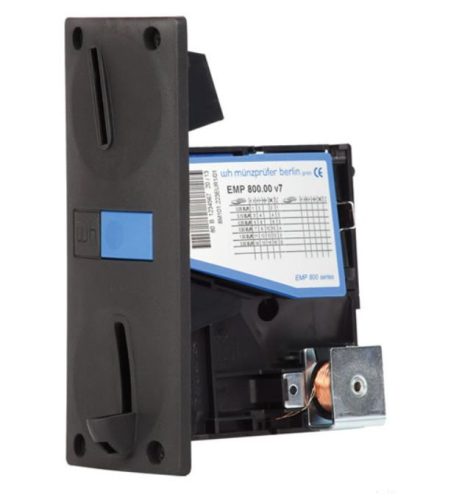
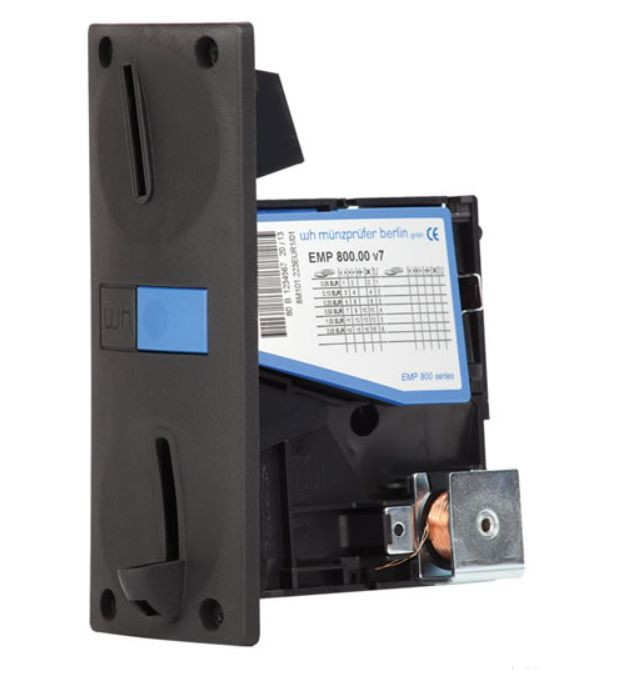
What are the technical specs of the WH Berlin EMP800.17 v7 32-channel coin validator ccTalk/MDB with front plate?
- item number: EMP80017v7
- acceptance rate: 98%
- supported denominations: 32
- max coin size: 32.5 x 3 mm
- operating temperature: 10°C to +70°C (/p option), -20°C to +70°C
- overall dimensions: 104 x 53 x 93,5 mm
- supply voltage: 10–26 V DC
- current consumption: 30–300 mA
- options: /e outdoor, /p indoor
- interfaces: parallel/cctalk, 2-price stepper, USB, MDB
- formats: plastic front plate, metal front plate, frame-mount variants
- weight: 300 g/db
What does a 32-channel coin validator do in a cash-handling flow?
A 32-channel validator identifies coins quickly and consistently, then provides a clear accept/reject decision to your controller. The WH Berlin eMP800.17 v7 32-channel coin validator ccTalk/MDB with front plate is a strong fit when throughput and stable behavior directly impact customer flow and revenue. the 40 MHz processor and 98% acceptance rate support predictable operation under repeated daily use.
Where does EMP80017v7 fit best?
Parking payment points, car wash systems, ticketing machines and other unattended payment locations typically require wide temperature tolerance and robust recognition. the indoor (/p) and outdoor (/e) options help you choose the right build for the environment, while the 10–26 V DC supply range eases integration into existing power architectures.
How do ccTalk, MDB, USB and parallel-style interfaces affect integration?
Interface choice determines how easily you can connect the validator to your controller and other payment peripherals. With multiple interface options, you can align your system architecture to your preferred protocol, improve diagnostics and keep configuration consistent across fleets. This becomes especially valuable when you need quick swaps on site and fast restoration of the same operating settings.
Which mechanical and electrical points should you validate during design?
Use the overall dimensions ( 104 x 53 x 93,5 mm ) to plan mounting points, coin entry alignment and the reject path. Misalignment increases friction and can slow down processing or raise the risk of sticking. Max coin size (32.5 x 3 mm) helps you frame token and coin sets. On power, confirm voltage stability and grounding so current peaks within the 30–300 mA range don’t cause intermittent states, especially when multiple peripherals share the same rail.
Selection criteria checklist
Function and performance
- confirm 32 channels cover your coin/token set and that configuration can be documented and repeated
- validate stability and acceptance behavior under high-traffic duty cycles
- design the reject path to minimize dirt build-up around the entry zone
Interface and controller
- choose the interface that matches your controller (ccTalk, MDB, USB or parallel) and standardize wiring
- prepare for field replacement: labeled harnesses and fast restoration of the same settings
- add diagnostics to separate issues quickly (coin path, sensors, power)
Environment and durability
- select indoor (/p) or outdoor (/e) based on temperature and exposure
- protect the front area against dust and splash in the mechanical design
- ensure service access for cleaning, visual inspection and rapid module swaps
How do quality, local service and maintenance protect uptime?
Continuous-duty cash handling depends on precise installation and consistent maintenance. Routine cleaning, entry-area inspection and adherence to operating conditions reduce sticking and false rejects. Local technical support helps you align integration details, commissioning practices and on-site troubleshooting, which can significantly shorten downtime when deployments scale.
- preventive maintenance: cleaning, functional checks, coin path inspection, mounting review
- operating conditions: temperature and humidity control, stable power, vibration management
- service support: spare handling, configuration assistance, documented settings
Supply, logistics and financing options that help projects move
- stock availability for critical modules and accessories
- timed arrivals aligned to rollout waves
- flexible shipping methods for standard and urgent needs
- customs and forwarding support for smoother logistics
- post-payment and invoicing in foreign currency for cash-flow planning
- project-tailored quotations based on quantities, schedule and integration scope
CTA: add items to your interest list and send it at the end of your visit
If you find coin entry parts, escrow modules, chassis components, payout units or anti-pin accessories that could be useful beyond your current rollout, add them to your interest list (cart). At the end of your visit, send the list and you’ll receive feedback on compatibility, stock status, delivery options and a project-aligned quotation.
FAQ
Why does 32-channel recognition matter in high-traffic payment points?
More channels allow flexible coin and token handling while keeping settings repeatable across fleets. that supports consistent transactions and faster recovery after field replacement.
Which interface should I choose: ccTalk, MDB or USB?
Choose based on your controller and peripheral standard. ccTalk and MDB are common for cash modules, while usb can be convenient for commissioning and service workflows. the key is standardized wiring, protocol handling and diagnostics.
What enables faster on-site replacement and restart?
Documented configuration, labeled harnesses and service-friendly mounting. when settings are restored quickly and the reject path is easy to access, downtime drops significantly.
What industrial capabilities are often missing from simpler solutions?
Typical differences are higher duty-cycle tolerance, wider environmental range, more interface options and better serviceability with longer-term spare strategies—important when uptime and predictable cash flow are critical.