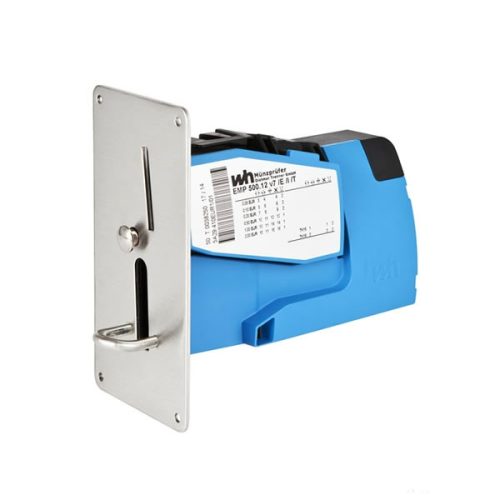
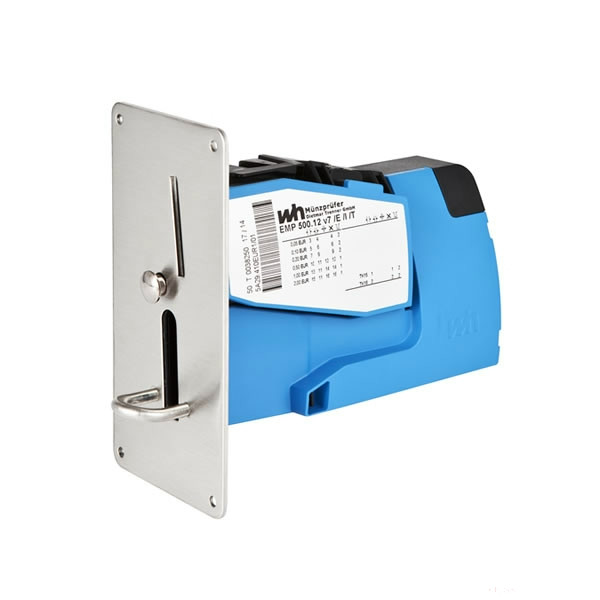
What are the WH Berlin EMP500.12v7 (EMP50012v7) technical specifications?
- product: WH Berlin EMP500.12v7 coin acceptor
- item number: EMP50012v7
- coin recognition: up to 32 coin types; 2 coin block signals
- data interface: pulse
- outputs: two optocoupler-isolated pulse outputs; pulse length 50 ms (±2%) to 10 s
- supply voltage: 11–30 V DC, 13,5–24 V AC (wide range for voltage fluctuation tolerance)
- operating temperature: +10 °C to +70 °C; option /e: -20 °C to +70 °C
- max coin size: 30 mm diameter; 3.3 mm thickness
- dimensions (without faceplate): 77.3 mm (h) × 40 mm (w) × 125 mm (d)
- weight: 300 g/pcs
- marked use/operation: vending; acceptance
- options: /i inventor pulse, /t teachable mode (2 coin channels enabled), /u potential-free opto coupling to the controller
When is a 32-channel electronic coin selector the right choice?
If your machine runs in high-traffic environments and you need consistent coin recognition with predictable controller signalling, a 32-channel electronic selector is typically the right direction. The EMP500.12V7 (EMP50012V7) is positioned as a reliable alternative where mechanical selectors were traditionally installed, which can reduce mechanical rework and keep installation straightforward. On the electronics side, the PULSE interface and optocoupler isolation support clean integration, while the wide voltage range helps avoid nuisance issues caused by site-level fluctuations.
What do pulse signalling and optocoupler isolation mean for your controller?
With pulse signalling, your controller interprets value from pulse patterns, so timing stability matters. Optocoupler isolation helps reduce ground-loop and interference-related errors, which can translate into fewer false events and less downtime. The configurable pulse length (from 50 ms up to 10 seconds) also makes the unit easier to match to existing input expectations without redesigning your controller I/O.
Selection criteria: what should you verify before ordering?
- coin set: which coins and tokens must be supported (up to 30 mm diameter, 3.3 mm thickness)
- integration: pulse inputs, isolation requirements, pulse length and controller logic
- power planning: 11–30 V DC or 13,5–24 V AC availability and stability on site
- environment: +10–+70 °C; use /e option if your sites require -20–+70 °C capability
- mechanical envelope: 77.3 × 40 × 125 mm (without faceplate), mounting and service access
- operations: cleaning routine, coin path inspection, setup and verification runs
How do you plan for quality, local support and preventive maintenance?
High availability depends on both component quality and disciplined operation. In dusty or vibration-prone sites, coin path cleanliness directly impacts recognition accuracy and repeatable signalling. Plan service access at the design stage so preventive checks can be performed quickly. Local technical support and an efficient service workflow become especially valuable when a payment point outage creates immediate revenue loss.
- clean the coin entry and coin path; remove dust and residues
- verify stable supply conditions across 11–30 V DC / 13,5–24 V AC
- pre-peak checks: validate pulse signalling, test multiple coin types and log anomalies
- local service support: diagnostics, replacement workflow and documentation
Supply, logistics and financial options for your project
For multi-site rollouts, procurement timing and commercial flexibility drive schedule predictability. Align deliveries to deployment phases and keep room for cost and cash-flow optimisation.
- local stock and scheduled inbound deliveries matched to your installation plan
- selectable shipping modes plus customs handling and forwarding
- post-payment, multi-currency invoicing and project-specific quotations
Add relevant components to your interest list
If you are comparing payment and peripheral modules, add the items that could also fit future iterations. Collect your selections into an interest list (cart) and send it at the end of your visit—this speeds up technical alignment, shipping choices and project-specific commercial terms.
FAQ
Why does a wide supply range matter for coin acceptors?
A wide 11–30 v dc and 13.5–24 v ac range helps tolerate real-world voltage fluctuations, supporting stable recognition and reducing nuisance downtime.
What do industrial electronic coin selectors provide beyond entry-level devices?
You typically get higher channel count, more consistent signalling and integration options such as teachable mode or potential-free opto coupling, which help during controller integration.
How can you reduce false acceptance and signalling issues?
Keep the coin path clean, ensure stable power and match pulse length to your controller inputs. running multi-coin verification before peak hours and logging events also helps isolate root causes.
What should you prepare for fast replacement or expansion?
Maintain documented wiring, signal mapping and a test procedure. after a swap you can quickly verify pulse outputs and acceptance logic without extended downtime.