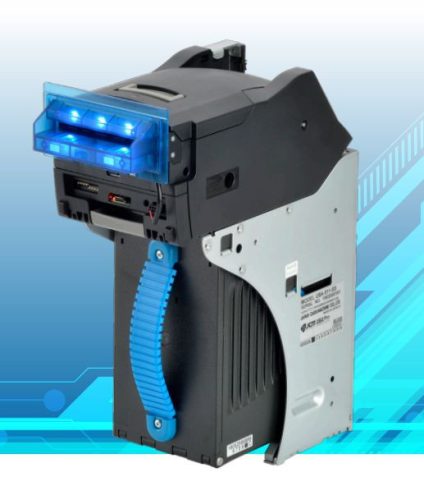
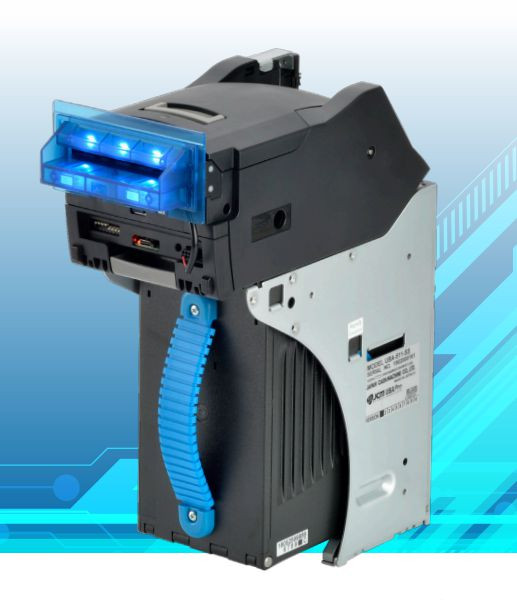
What are the technical specifications of the JCM UBA pro banknote acceptor (47202382)?
- acceptance rate: 98% or greater
- banknote size (centering type, uba-5x0 series): long side 120–165 mm, short side 62–85 mm
- insertion: banknotes 4-way; barcode tickets 2-way (face up), 4-way as an option
- validation speed: 2.2 seconds or faster note-to-note
- dimensions (w×h×d): 301.1 (h) × 225 (d) × 114 (w)
- weight: approx. 4 kg (unit+frame+500-note cash box); listed weight 4.85 kg/pcs
- supply voltage: 12 V dc (−5%) to 24 v dc (+5%), >70 w recommended
- current draw: at 12 V standby 0.3 a, operation 1.8 a, peak 4.0 a; at 24 v standby 0.2 a, operation 0.9 a, peak 2.0 a
- cashbox capacity: 500 or 900 new banknotes
- interfaces: usb 2.0 (full speed 12 mbps), photo-coupler isolation, rs232c, cctalk, ttl
- environment: operating 5–50 °c; storage −20–60 °c; humidity 15–85% rh (non-condensed)
- compatibility: head unit works with several existing frames, harnessing, voltages, interfaces and cash boxes
Where does this banknote acceptor fit best in an industrial build?
use this banknote acceptor when your system must handle cash payments with short cycle times and minimal user friction. 4-way insertion helps reduce orientation mistakes, and the centering mechanism supports stable sensing for mixed-condition notes. the 900-note cashbox is valuable when you want fewer cashbox swaps and you prefer to align service work with planned maintenance windows, for example combining cashbox exchange with other peripheral checks. because it supports 12–24 v dc and multiple integration interfaces, it can be mapped to common controller architectures and installed alongside other payment and control modules without redesigning the power domain.
What should you plan for during integration?
Mechanical integration and service access
this configuration is supplied without the front plate and cable, so plan the bezel/opening geometry, mounting points, and compatible harnessing. Make sure the enclosure allows safe cashbox removal and gives technicians access to the note path for routine inspection and cleaning. Service-friendly layouts typically reduce downtime and keep maintenance effort predictable in long-running deployments.
Power stability and interface selection
Use a stable 12 v or 24 v dc supply with at least 70 W headroom and account for peak current. plan grounding, cable routing and emc practices early, especially if the cabinet contains motors, printers or other high-noise modules. standardizing on one interface (USB, RS232C, ccTalk or TTLl) across peripherals often simplifies commissioning, logging and field diagnostics.
Selection criteria: how to choose a banknote acceptor for a project
- throughput target: peak transactions and acceptable user wait time
- note size range: fit to the currencies and ticket formats you need to handle
- insertion flexibility: 4-way acceptance to reduce user errors and speed up flow
- cashbox capacity: 500 vs 900 notes based on your emptying routine
- interface fit: usb/rs232c/cctalk/ttl mapped to your controller and software stack
- environment and access: temperature, humidity, dust exposure, vibration and serviceability
Quality, maintenance and local technical support
- run preventive cleaning for the note path and sensors, because dust and deposits can increase misreads and reject rates.
- keep operation within the specified temperature and humidity range and design the enclosure to avoid condensation.
- manage firmware and software updates in a controlled way so recognition and peripheral handling stay consistent.
- use local technical support and service capabilities through the full lifecycle to speed up troubleshooting and reduce downtime.
Procurement and financing options that improve delivery and rollout
- inventory availability and scheduled inbound deliveries to match installation milestones
- selectable shipping methods, plus customs handling and freight forwarding where needed
- post-payment and invoicing in foreign currency to fit your finance process
- project-specific quotations when multiple components are planned together
CTA: save it to your interest list and send the list at the end of your visit
if this banknote acceptor is relevant, add it to your interest list and also collect other components that may be useful in future rollouts. at the end of your visit, send the list so requirements (power, interface, cashbox capacity), delivery options and payment terms can be aligned in one step, and you can receive a project-tailored quotation.
- collect reusable items that can support multiple deployments
- note your target interface (usb/rs232c/cctalk/ttl) and supply voltage (12/24 v)
- share expected daily transaction volume and the planned emptying schedule
FAQ
What do industrial banknote validators provide beyond fast recognition?
they typically combine multi-sensor authentication with stable note centering, helping reduce false accepts and unnecessary rejects, especially with mixed-condition notes. that consistency supports smoother customer flow at peak times.
Why does 4-way banknote insertion matter for throughput?
it reduces orientation-related user errors, so transactions complete faster without forcing the user to rotate the note. That helps keep queues shorter and improves the user experience.
What maintenance helps keep acceptance rates stable?
regular cleaning of the note path and sensors, plus inspection of rollers and guides. in dusty environments, shorten the cleaning interval to avoid deposit build-up that can trigger misreads.
How do industrial acceptors differ from entry-level devices?
they tend to offer faster processing, higher first-time acceptance, more integration interfaces for controllers, and stronger protection against manipulation attempts. this package is better suited for continuous-use duty cycles.